During festa season in Malta, villages across the islands are transformed by thousands of lights, colourful banners, religious processions, brass bands and spectacular fireworks. More than simply a celebration, the Maltese festa is one of the country's most distinctive traditions and an essential part of local community life.
Each village or parish celebrates its patron saint, turning streets and squares into elaborate displays of devotion and popular celebration. Church façades are illuminated, balconies are decorated and garlands of red, blue and other colours stretch above the streets.
For visitors, attending a village festa in Malta offers a unique opportunity to experience a tradition in which religion, history, family and community come together.
What is a festa in Malta?
A festa in Malta is a traditional feast organised by a parish in honour of its patron saint. Although religion lies at the heart of the celebration, the Maltese festa extends far beyond the church itself. For several days, and sometimes longer, the
surrounding village changes rhythm.
Streets are decorated with banners, flags, statues and lights. Brass bands accompany celebrations through the town, religious processions bring the patron saint into the streets and fireworks illuminate the sky.
The result is one of the most characteristic expressions of Maltese culture and tradition: a celebration that is both sacred and popular, solemn and exuberant.
Why are Maltese festas decorated with lights?
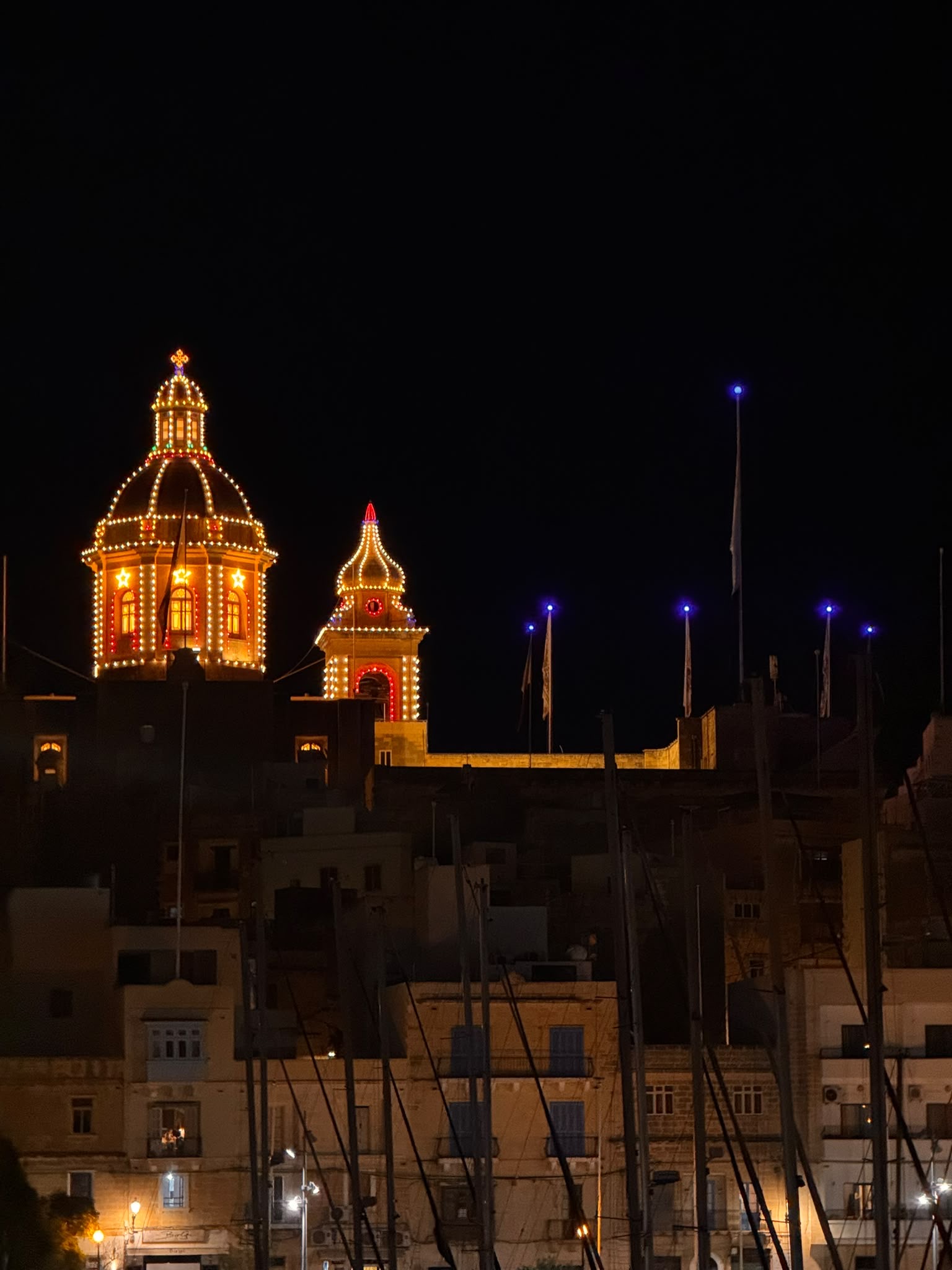
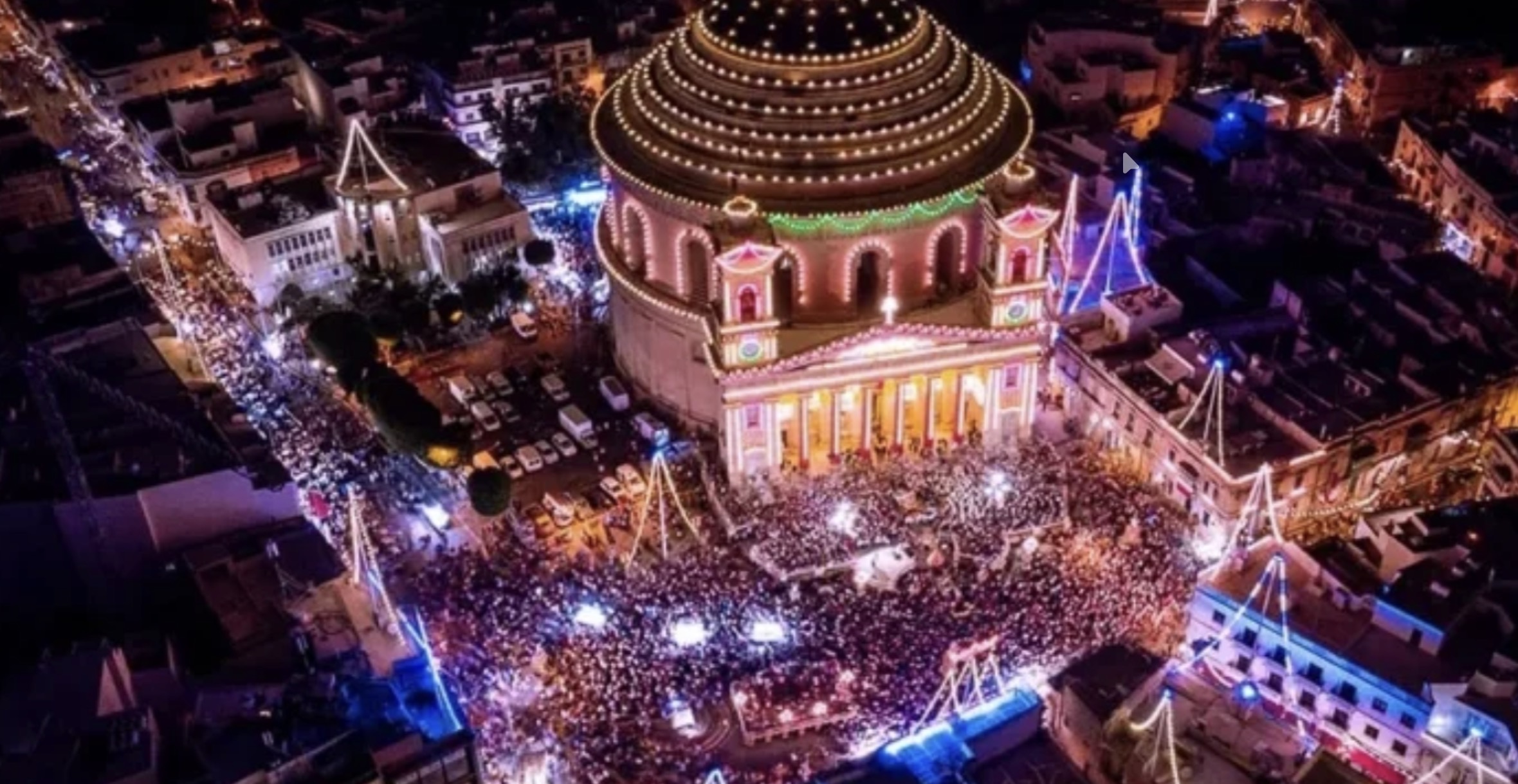
One of the most spectacular features of a traditional Maltese festa is its illumination.
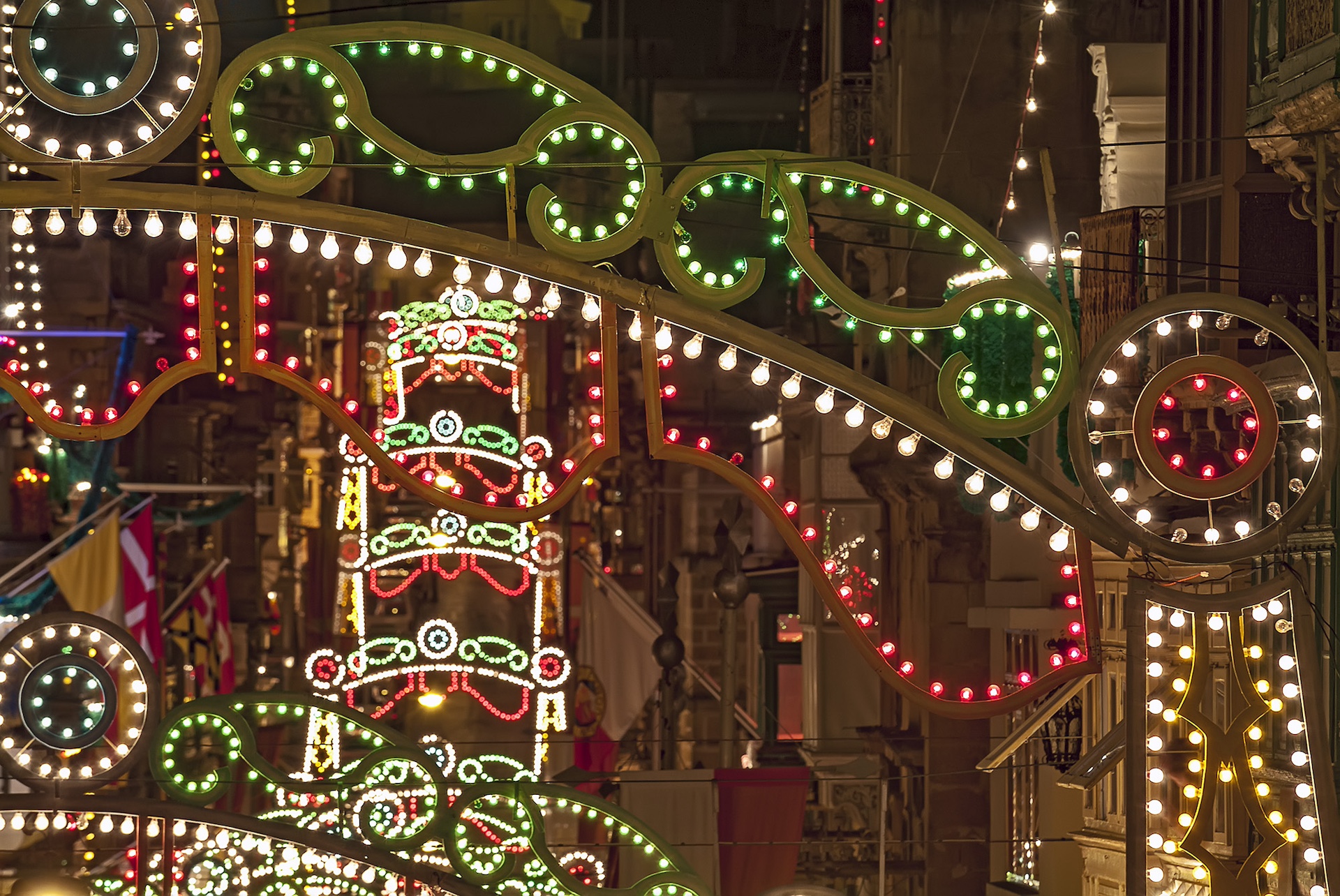
As the feast approaches, churches, streets and village squares are covered in elaborate lights. After sunset, entire façades can be outlined by hundreds of bulbs, transforming familiar architecture into a theatrical nighttime landscape.
These illuminations are not simply decorative. They highlight the parish church, the spiritual and symbolic centre of the community, while creating a setting worthy of the saint being celebrated.
During the procession, the relationship between architecture, religious statues and light gives the festa much of its dramatic character. In Malta, for a few nights, the village itself becomes a stage.
The meaning of colours during a Malta festa
Colours play an important role in Maltese festas, and decorations often reflect the identity of the parish and its patron saint.
Blue is traditionally associated with the Virgin Mary and can evoke purity and protection. Red can represent passion, sacrifice and spiritual strength, while also being associated with saints such as Saint George, whose martyrdom and courage are central to his iconography.
Other colours and combinations can appear depending on the parish, saint and local tradition. From one village to another, these visual codes help create a distinctive identity. Decorations are therefore not simply chosen for their aesthetic appeal: they can tell a local story rooted in religious traditions passed down through generations.
Red and blue also have another, more secular resonance in Malta. The colours are strongly associated with the country's two main political traditions: red with the Labour Party and blue with the Nationalist Party. This political association is separate from the religious meaning of festa decorations, but it illustrates just how present these two colours are in Malta's
visual culture.
Every Maltese village has its own patron saint
The extraordinary diversity of Malta's village festas comes from the importance of individual parishes and their patron saints. Devotion to the Virgin Mary occupies a particularly important place, including celebrations dedicated to the Assumption and the Immaculate Conception.
Other prominent patron saints celebrated across Malta include Saint Paul, Saint Joseph, Saint John the Baptist, Saint Peter, Saint Andrew and Saint George.
Saint Sebastian, Saint Catherine, Saint Lucy, Saint Agatha, Saint Margaret, Saint Anne, Saint Julian, Saint Publius, Saint Nicholas, Saint Dominic and Saint Francis of Assisi are among the many other figures honoured by Maltese parishes.
Each celebration has its own character. The patron saint can influence the colours, emblems, hymns, statues and decorations associated with a particular festa.
This strong local identity explains why experiencing one Maltese festa does not necessarily mean you have experienced them all.
When is festa season in Malta?
The Malta festa season begins in late spring and reaches its height during the summer months. From roughly June to September, festas take place across Malta and Gozo, with numerous celebrations occurring during the weekends. Processions, band
marches, street decorations and fireworks give the islands a distinctive atmosphere throughout the season.
For travellers visiting Malta in summer, it is therefore common to encounter a festa simply by exploring different towns and villages. The exact Malta festa calendar changes according to the parish and year, so visitors wishing to attend a particular celebration should check local schedules before travelling.
Processions, brass bands and fireworks
While the illuminated streets are among the most immediately recognisable features of a Maltese village festa, they are only one part of the experience. Religious processions remain central to the celebration. Statues of patron saints are carried through the streets as residents gather along the route and decorated balconies overlook the procession.
Music is equally important. Local band clubs, deeply rooted in Maltese community life, accompany many celebrations and contribute to the lively atmosphere in the streets.
Then come the fireworks.
Malta has developed a particularly strong tradition of festa fireworks, with displays ranging from daytime petards to elaborate nighttime shows. During the height of summer, their sound and light can be experienced across the islands.
Together, processions, music, decorations and fireworks create the unique mixture of devotion and spectacle associated with the Maltese festa.
The festa: a living Maltese tradition
The importance of the festa extends beyond the celebration of a particular saint. For local communities, preparing a village for its annual feast involves traditions, organisations and knowledge passed down between generations.
Churches, band clubs, volunteers, families and neighbourhood groups all contribute to the event. The festa therefore expresses something fundamental about community life in Malta.
Streets that are ordinarily places of everyday activity become collective spaces. Residents decorate their homes and neighbourhoods, families gather and the identity of the parish becomes visible throughout the village.
Rather than belonging solely to Malta's past, the festa remains a living tradition that continues to evolve with the communities that celebrate it.
Experiencing a traditional festa in Malta
For visitors, attending a traditional festa in Malta can reveal a very different side of the islands. During the day, decorated streets, banners and statues gradually build anticipation. As evening arrives and the lights come on, the atmosphere changes. The illuminated church becomes the centre of the village, music fills the streets and residents gather for the celebrations. Each festa has its own personality, shaped by its patron saint, parish and local traditions.
It is this combination of faith, spectacle and community that makes the Maltese festa one of the island's most distinctive cultural experiences. For several months each year, Malta seems to move from one celebration to another. And when the lights illuminate the churches and streets after sunset, an ancient tradition takes on a new life — one village at a time.